
You don’t need a $50,000 agency retainer to look like a real business[1]. You need a logo that doesn’t look like it was made in five minutes (even if it was), two or three colors you use everywhere, a font pairing you don’t change every month, and a handful of sentences that explain what you do and why anyone should care.
That’s it. That’s a branding kit.
Somewhere along the way, “branding” turned into a word that scares small business[8] owners away from doing it at all. Agencies quote five figures, blog posts throw around terms like “brand equity” and “positioning matrix,” and the whole thing starts to feel like something only funded startups can afford. It isn’t. A branding kit built for under a few hundred dollars, or even for free if you’re handy with a template, can do 80% of what the expensive version does — especially in the early stage when your biggest job is just being consistent everywhere people find you.
Learn the passive income models behind real net worth stories.
Simple strategies • Beginner-friendly • Practical
Get the Passive Income PlaybookThis post breaks down what actually belongs in an affordable branding kit, what it should cost at different budget levels, and how to put one together without hiring a full creative team.
What a Branding Kit Actually Is
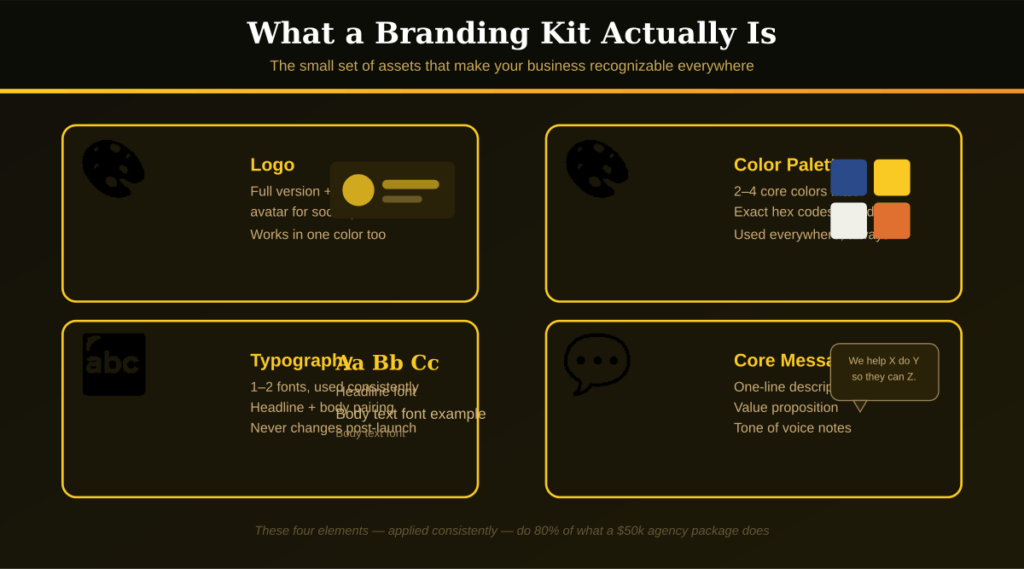
A branding kit is the small set of visual and messaging assets that make your business[1] recognizable and consistent, no matter where someone runs into it — your website, your Instagram, your packaging, your invoices.
At minimum, it includes:
- A logo (and a simplified version for small spaces like social avatars)
- A color palette (2–4 core colors, not a rainbow)
- Typography (one or two fonts, used consistently)
- Core messaging (a one-line description of what you do, plus a short mission or value statement)
Some people call this a “brand kit,” others call it “brand in a box” or a “starter identity.” The Branded Agency has a detailed breakdown of what a full-service version of this looks like in their piece on branding in a box, and Shopify covers the higher-end packaging in their branding package guide — both worth a read if you want to see what the top end of this market looks like. But most small businesses don’t need the top end. They need the essentials, done well, and done fast.
Why Bother With a Branding Kit Before You’re “Big Enough”
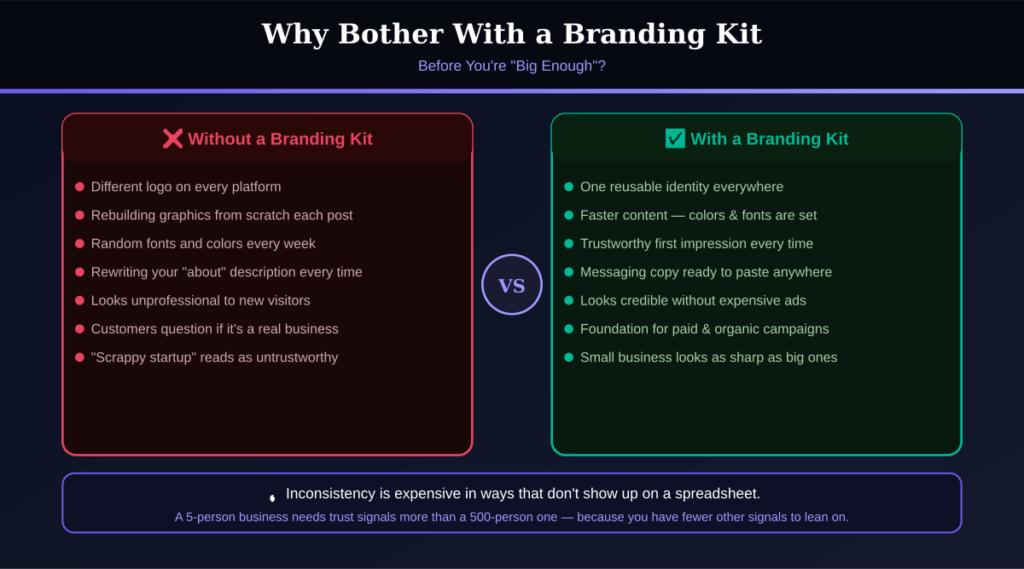
There’s a common trap: waiting until the business[1] feels more established before investing in how it looks. The problem is that inconsistency is expensive in ways that don’t show up on a spreadsheet. A customer who sees three different logo styles across your website, your packaging, and your Instagram bio doesn’t think “scrappy startup energy” — they think “is this legit?”
A basic, affordable kit fixes that immediately. It gives you:
- One visual identity you can reuse everywhere instead of rebuilding graphics from scratch every time you post something
- Faster content creation, because you’re not starting from a blank canvas — you already know your colors, your fonts, your tone
- A more trustworthy first impression, which matters more for a five-person business[1] than a five-hundred-person one, because you have fewer other signals (reviews, press, scale) to lean on
- A foundation for future marketing, including the kind of paid and organic campaigns covered in this guide to small business advertising ideas — ads and promotions land a lot better when the creative behind them is already consistent
None of this requires a five-figure agency engagement. It requires picking the right handful of assets and sticking to them.
Learn the passive income models behind real net worth stories.
Simple strategies • Beginner-friendly • Practical
Get the Passive Income PlaybookThe Core Pieces of an Affordable Branding Kit
1. A Logo You Can Actually Use Everywhere
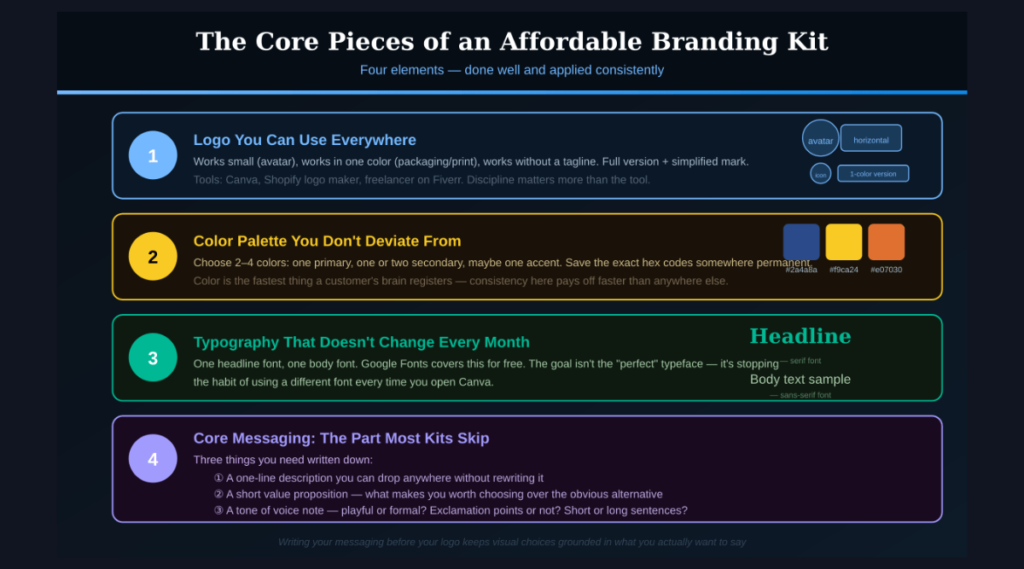
Your logo needs to work small (a social media avatar), work in one color (for stamping on packaging or printing on a t-shirt), and work without a tagline crammed underneath it. If your only logo file is a giant, detailed PNG that turns to mush the second you shrink it, that’s the first thing to fix.
You don’t need five logo concepts and three rounds of revisions from a design agency to get there. A freelance designer, a well-used template from a tool like Canva, or even Shopify’s free logo maker can get you a clean, versatile mark. What matters more than the tool is discipline afterward — once you pick a logo, stop redesigning it every few months.
2. A Color Palette You Don’t Deviate From
Pick two to four colors. One primary, one or two secondary, maybe an accent. Write down the exact hex codes somewhere you’ll actually find them again (a Google Doc, a Notion page, a note pinned to your desktop — doesn’t matter, just somewhere permanent).
Color does real work here. It’s one of the fastest things a customer’s brain registers, and it’s a huge part of why certain brands feel instantly recognizable even before you consciously notice the logo. If you’re naming or branding something in a specific niche — say a modest fashion label or a specialty food business[1] — pairing the right palette with the right name matters even more, and it helps to start with strong name options first. Lists like this one on hijab business name ideas or this one on chocolate business name ideas are a good place to start if the name isn’t locked in yet, since your palette and logo style should follow from the name and niche, not the other way around.
3. Typography That Doesn’t Change Every Month
Pick one font for headlines and one for body text. If you only want to manage one font total, that’s fine too — just be consistent. The goal isn’t to find the “perfect” typeface; it’s to stop using Canva’s default suggestion on one graphic and a completely different font on the next.
Free font pairings from Google Fonts cover this need for the vast majority of small businesses. You don’t need a custom typeface commissioned from scratch unless you’re already generating serious revenue[2] and want that extra layer of distinctiveness.
4. Core Messaging: The Part Most Kits Skip
This is the piece that gets ignored in a lot of DIY branding efforts, and it’s arguably more important than the visuals. You need:
- A one-line description you can drop into a bio, an “About” page, or an elevator pitch without rewriting it every time
- A short value proposition — what specifically makes your product or service worth choosing over the obvious alternative
- A tone of voice note — are you playful or formal? Do you use exclamation points or avoid them? Short sentences or longer ones?
Write these down. Not because you’ll never deviate, but because every piece of content you produce — social captions, email subject lines, product descriptions — gets faster and more consistent once you’re not reinventing your voice from scratch each time.
How Much Should an Affordable Branding Kit Cost?
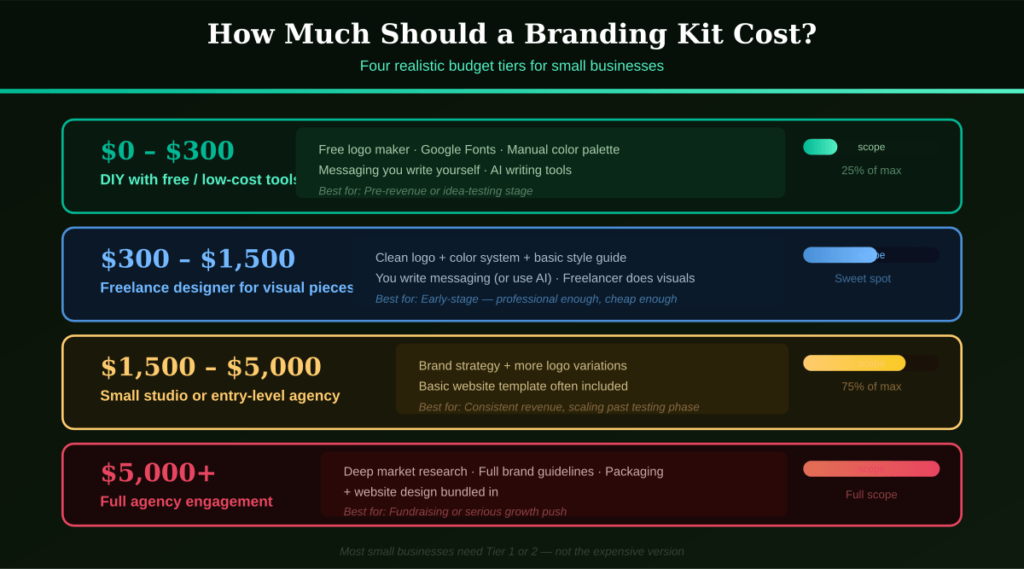
Pricing for branding work swings wildly, and most of that swing comes down to scope and who’s doing it. Here’s a realistic breakdown for the budget-conscious end of the spectrum:
$0–$300 — DIY with free or low-cost tools. A free logo maker, Google Fonts, a manually chosen color palette, and messaging you write yourself using a simple framework. This is the right tier if you’re pre-revenue[2] or testing an idea before committing more money.
Learn the passive income models behind real net worth stories.
Simple strategies • Beginner-friendly • Practical
Get the Passive Income Playbook$300–$1,500 — A freelance designer for the visual pieces. You handle the messaging yourself (or with an AI writing assistant), and a freelancer builds out a clean logo, color system, and basic style guide. This is the sweet spot for most early-stage small businesses — professional enough to look credible, cheap enough to not create financial pressure.
$1,500–$5,000 — A small studio or entry-level agency package. This usually adds brand strategy work, more logo variations, and sometimes a basic website template. Worth it once you have consistent revenue[2] and are scaling past the “figuring it out” phase.
Anything above that tends to include deeper market research, full brand guideline documents, and packaging or website design bundled in — useful for a company preparing for a serious growth push or fundraising round, but overkill for most businesses just trying to look put-together.
Building Your Kit: A Simple Order of Operations
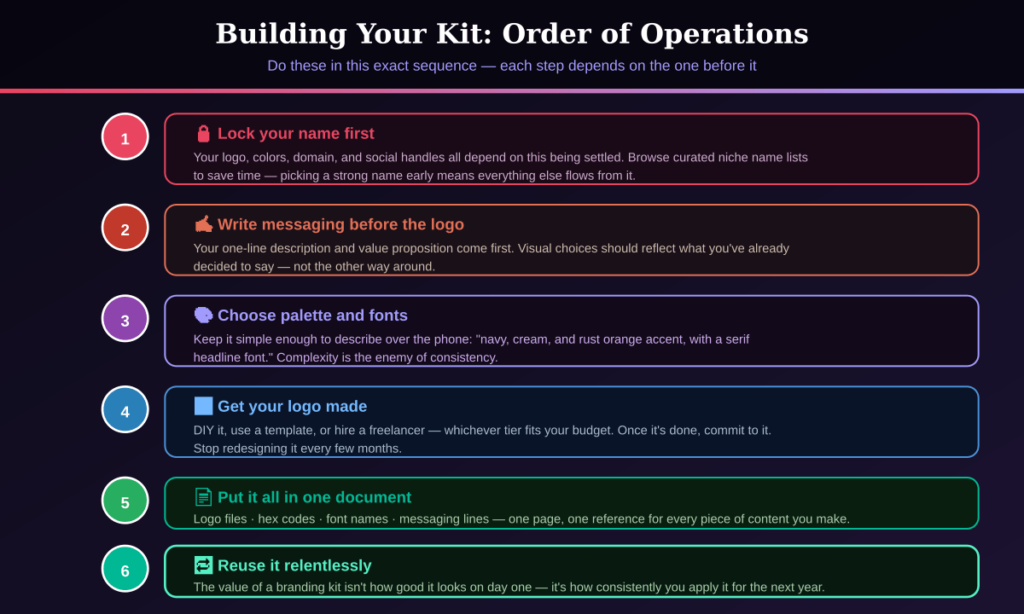
- Lock your name first. Everything else — logo, colors, domain, social handles — depends on this being settled. If you haven’t picked one yet, browsing curated name lists for your specific niche saves a lot of back-and-forth later.
- Write your one-line description and value proposition. Do this before the logo, not after. Visual choices should reflect what you’ve already decided to say about the business.
- Choose your color palette and fonts. Keep it simple enough that you could describe it to someone over the phone: “navy, cream, and a rust orange accent, with a serif headline font.”
- Get your logo made. DIY it, use a template, or hire a freelancer — whichever fits your budget from the tiers above.
- Put it all in one document. A single page with your logo files, hex codes, font names, and messaging lines. This becomes your reference every time you make anything — a social post, a flyer, packaging, an ad.
- Reuse it relentlessly. The value of a branding kit isn’t in how good it looks on day one. It’s in how consistently you apply it for the next year.
Skip the Guesswork: Get a Ready-Made Starter Kit
If step-by-step DIY branding still feels like more than you have time for right now, you don’t have to build the framework from scratch. The Business Starter Kit ebook walks through the exact building blocks — naming, positioning, and the early branding decisions — that most small businesses spend weeks fumbling through on their own. It’s built specifically for founders who want the essentials without paying agency prices to get them.
Grab it before your next big launch, product drop, or rebrand — it’s a lot easier to get this right at the start than to fix inconsistent branding two years in.
The Bottom Line
An affordable branding kit isn’t a stripped-down, lesser version of “real” branding. For a small business[8], it’s often the more sensible version — a tight set of assets you’ll actually use consistently, instead of an elaborate guideline document that gets built once and never opened again.
Nail the basics — logo, colors, fonts, messaging — apply them everywhere, and revisit the kit once a year or so as the business grows. That’s a branding foundation most companies twice your size still haven’t gotten right.
Ready to put the pieces together the easy way? Download the Business Starter Kit and skip the months of trial and error.
References
- [1] Wikipedia Contributors. (2024). Business. Wikipedia, The Free Encyclopedia. https://en.wikipedia.org/wiki/Business
- [2] Investopedia. (2024). Business: Definition, Types, and Concepts. Investopedia. https://www.investopedia.com/terms/b/business.asp
- [3] Salesforce. (2024). Types of Businesses: A Complete Guide. Salesforce Small Business Resource Center. https://www.salesforce.com/small-business/types-of-businesses/
- [4] Entrepreneur Staff. (2024). 55 Business Ideas. Entrepreneur. https://www.entrepreneur.com/starting-a-business/need-a-business-idea-here-are-55/201588
- [5] DHL Discover. (2024). 7 Business Ideas for Nigerian Entrepreneurs. DHL Discover. https://www.dhl.com/discover/en-ng/small-business-advice/business-innovation-trends/-7-business-ideas-for-nigerian-entrepreneurs
- [6] Forbes Advisor. (2024). How to Start a Business: A Step-by-Step Guide. Forbes Advisor. https://www.forbes.com/advisor/business/how-to-start-a-business/
- [7] World Bank Group. (2023). Starting a Business – Explore Topics. Doing Business, World Bank. https://archive.doingbusiness.org/en/data/exploretopics/starting-a-business
- [8] Entrepreneur Staff. (2024). How I'd Build My Small Business If I Had to Start Over. Entrepreneur. https://www.entrepreneur.com/starting-a-business/how-id-build-my-small-business-if-i-had-to-start-over-in/503494
- [9] U.S. Small Business Administration. (2024). 10 Steps to Start Your Business. SBA.gov. https://www.sba.gov/business-guide/10-steps-start-your-business
- [10] ResearchGate Authors. (2024). The Business Start-up Procedures and Costs for Entrepreneurs. ResearchGate. https://www.researchgate.net/publication/385789075_The_Business_Start-up_Procedures_and_Costs_for_Entrepreneurs
- [11] PMC / NCBI Authors. (2022). Entrepreneurship and Business Formation: A Research Perspective. PubMed Central (PMC). https://pmc.ncbi.nlm.nih.gov/articles/PMC9595277/
- [12] World Bank Group. (2023). Starting a Business – Research. Doing Business, World Bank. https://archive.doingbusiness.org/en/research/starting-a-business
References follow APA 7th edition citation style.